



Johnson / Cinch Connectivity Solutions SMA Self-Fixture End-Launch Connectors
Johnson / Cinch Connectivity Solutions SMA Self-Fixture End-Launch Connectors overcome the problematic gaps and RF path issues associated with inconsistent soldering processes. These connectors use a proprietary design to accurately align and hold the center contact to the circuit board plane without the need for special fixtures. Special connector legs tightly grip the center contact to the circuit board plane through the complete soldering process, allowing for consistent soldering work on a variety of PCB thicknesses. These connectors also eliminate poor connections that degrade signal quality.
Johnson / Cinch Connectivity Solutions SMA Self-Fixture End-Launch Connectors feature contacts and insulator material that form an optimized connection point. The contact maintains proper impedance under aggressive torque and axial stresses, while the insulator acts as a seal by compressing itself into the board edge during soldering. This creates a barrier between the inner and outer conductors and protects against solder bridging. The design allows the connectors to offer optimal return loss values for frequencies up to 26.5GHz.
These connectors are ideal for reducing the complexity of circuit board systems by eliminating the need for mounting screws, adapters, aftermarket tools, and more.
Features
- Designed to overcome inconsistencies in the soldering process
- Enhanced end-launch design with legs that align the center contact to the circuit board plane without the need for special fixtures
- Allows consistent soldering work on a variety of PCB thicknesses
- The terminals can provide circuit board support
- Save time in assembly processes
- Return loss up to 18GHz (26.5GHz for high-frequency model)
- Reduces complexity in circuit board designs
Specifications
- Mechanical
- 7in-lb. to 10in-lb. mating torque
- 500 cycles min. durability
- Electrical
- 50Ω impedance
- 0GHz to 26.5GHz frequency range
- 5000MΩ min. insulation resistance
- Environmental
- MIL-STD-202, Method 107, Condition B thermal shock
- -65°C to +165°C operating temperature
- MIL-STD-202, Method 101, Condition B corrosion
- MIL-STD-202, Method 213, Condition I shock
- MIL-STD-202, Method 204, Condition D vibration
- MIL-STD-202, Method 106 moisture resistance
Videos
Related Connectors
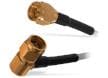
Johnson / Cinch Connectivity Solutions SMA Connectors
Wide range of 50Ω and 75Ω connectors offered in multiple mounting styles.

Johnson / Cinch Connectivity Solutions SMA High-Frequency End-Launch Connectors
Can be used on PC board substrate layers as thin as 8mm & operate at frequencies up to 26.5GHz.
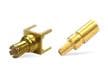
Johnson / Cinch Connectivity Solutions Non-Magnetic RF Connectors
Made from high-purity copper alloys with no ferrous materials, designed to carry 50Ω RF signals.